What determines healthspan, the term used to describe the number of years people live in good health and free from chronic disease? Muscle physiology plays a key role.
Christopher Sundberg
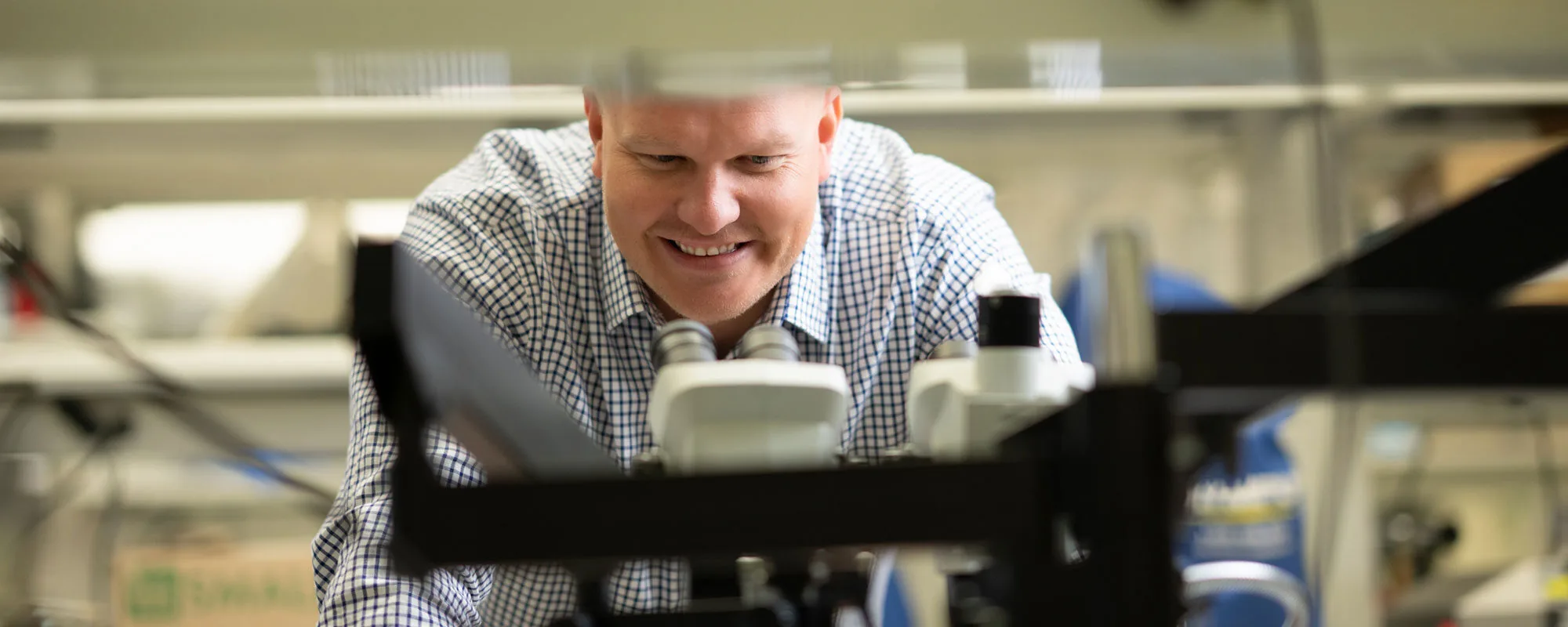
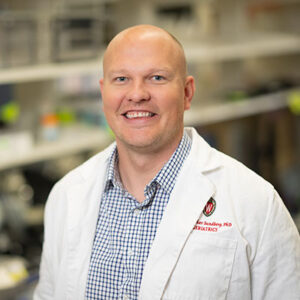
The field holds fascinating insights for researchers like Christopher Sundberg, PhD, an assistant professor of medicine in the UW School of Medicine and Public Health. Taking an integrative approach that includes cellular and molecular research as well as analysis of whole-body movement, Sundberg studies muscles for clues to why people lose strength faster than they lose muscle, why everyday tasks like climbing stairs become more fatiguing with age, and what interventions could protect those abilities.
Sundberg, who arrived at UW–Madison during the fall semester of 2025, makes his academic home in the UW School of Medicine and Public Health and devotes a portion of his time to the UW School of Education’s Department of Kinesiology, which helps support his work — for example, by providing access to specialized kinesiology research facilities.
The collaborative recruitment was part of UW–Madison’s RISE-THRIVE initiative, an effort to attract top scholars at all stages of their careers to focus on two key areas: the science of immunology and the study of the healthspan.
How do you describe your field and your research into how muscles age?
Integrative muscle physiology explores how our skeletal muscle function arises from coordinated processes across biological systems. Rather than studying muscles only under a microscope, or only in terms of whole-body movement, researchers in my lab make connections across all levels of biological scale. We measure how strong and powerful a muscle is, how quickly it fatigues and how it moves the body, and then we trace those outcomes back to the muscle fibers themselves, including the proteins that make them function, how they produce energy, and how they adapt to different stimuli, such as exercise. It’s an approach that asks not only, “What changes with aging?” but also “Why do those changes matter, and how do they affect everyday function?”
This field has evolved rapidly as advances in technologies, including artificial intelligence, allow us to connect detailed biological measurements directly to how muscles perform in people. In the context of aging, integrative muscle physiology provides a foundation for understanding mobility loss, fatigue and functional decline, which are issues that affect healthy aging. By linking biological changes to real-world outcomes, this work may help explain why people of the same age can have very different physical abilities and aging trajectories. It may ultimately improve strategies to support healthier aging for more people.
How did you become interested in studying muscle performance?
As a Division I-A student-athlete playing football at the University of Wyoming, I saw firsthand that athletic performance could vary dramatically among individuals, despite seemingly similar training programs, motivations and opportunities. Although we could measure and track outcomes such as speed, strength and endurance, we often lacked insight into the underlying physiological mechanisms driving these differences. Much of the variability in strength, fatigue and training adaptations remained unexplained. I came to appreciate that many performance-limiting factors were rooted in neuromuscular physiology, yet the mechanisms were poorly characterized, particularly in humans. This realization motivated my interest in studying muscle function across biological scales and ultimately led me toward a research career focused on the physiological factors that limit human performance across the lifespan.
What is exciting about your lab’s approach to studying aging muscle function, and how is it different from approaches used in the past?
Our lab is built on the idea that no single level of analysis is sufficient to truly understand muscle function. We study humans performing real tasks, like walking, generating force, and producing power, and then link those biomechanical measures to neuromuscular activation, single-fiber mechanics, and molecular alterations. What sets our work apart is that these measurements are not isolated; they come from the same individuals, allowing us to directly connect cellular and molecular biology to whole-muscle performance. By integrating all these approaches within the same study design, we hope to identify the mechanisms that cause fatigue and limit mobility and functional independence. This integrative framework is essential to designing effective targeted interventions.
Historically, many studies have examined molecular aging of muscle without direct linkage to functional outcomes, or they have characterized functional decline without identifying underlying mechanisms. As a result, we’ve often lacked a clear understanding of causality. By studying the entire system, we hope to identify which changes drive declines in power and fatigue, and which are simply bystanders. This approach should help us avoid targeting pathways that look interesting biologically but don’t meaningfully affect function.
… older adults living independently in the community tend to lose muscle power and fatigue more easily, mainly because of changes in the muscles themselves, not because the brain is failing to activate the muscles.
Christopher Sundberg
Why do older adults lose muscle power and tire more easily during exercise?
Our research shows that older adults living independently in the community tend to lose muscle power and fatigue more easily, mainly because of changes in the muscles themselves, not because the brain is failing to activate the muscles. One of the biggest reasons for the loss of power is the atrophy of fast-twitch muscle fibers, which are the fibers that help us move quickly — for example, catching ourselves when we trip. In young adults, these fast-twitch fibers can produce several times more power than slow fibers, so when they shrink with age, overall muscle power drops disproportionately to the overall muscle mass.
We have also found that muscle fibers from older adults are not uniquely more sensitive to metabolic byproducts that accumulate during exercise, such as hydrogen ions and inorganic phosphate. Instead, older muscles appear to work less efficiently, causing these fatigue-related substances to accumulate more quickly. Together, these findings suggest that interventions designed to preserve fast-twitch muscle fibers and improve muscle efficiency are needed to help older adults stay stronger, less fatigued, and more independent as they age.
What have you discovered that offers hope for healthy lifespan?
We’ve learned that declines in mobility arise from multiple subtle but meaningful changes in neuromuscular function. Many of these age-related changes are plastic and responsive to intervention. Targeted exercise programs, especially those informed by underlying physiology, can restore muscle power and improve fatigue resistance, even very late in life. This provides real hope that improving healthspan is an achievable goal.
You describe your lab as a “translational bridge.” What does this look like?
In addition to collaborating closely with basic scientists who use preclinical models to understand muscle biology, we also partner with clinicians and applied scientists to design and test interventions aimed at preserving muscle function. These efforts typically include targeted exercise strategies and training programs informed directly by our mechanistic findings, but we have also explored dietary interventions. By grounding interventions in fundamental biology, we increase the likelihood that they will effectively preserve mobility and healthspan in our aging communities.
Why is UW–Madison a great place to work?
People at UW-Madison genuinely want to collaborate to solve complex problems, and they view research on aging not as a niche interest but as a campuswide priority. It’s one of the few universities where world-class basic science, clinical research, and community engagement all happen under the same roof. I feel incredibly fortunate to have found an academic home where the mission of my research aligns so directly with a university-wide initiative. It’s the kind of environment where big ideas are not only welcomed but are supported with the resources needed to bring them to life.