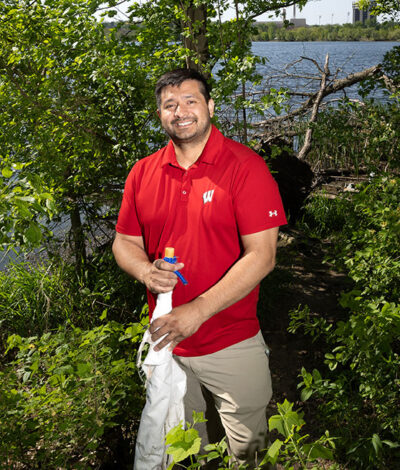
While most people dread finding a tick stuck to their clothing or skin, Johnny Uelmen is literally beating the bushes for them.
Johnny Uelmen
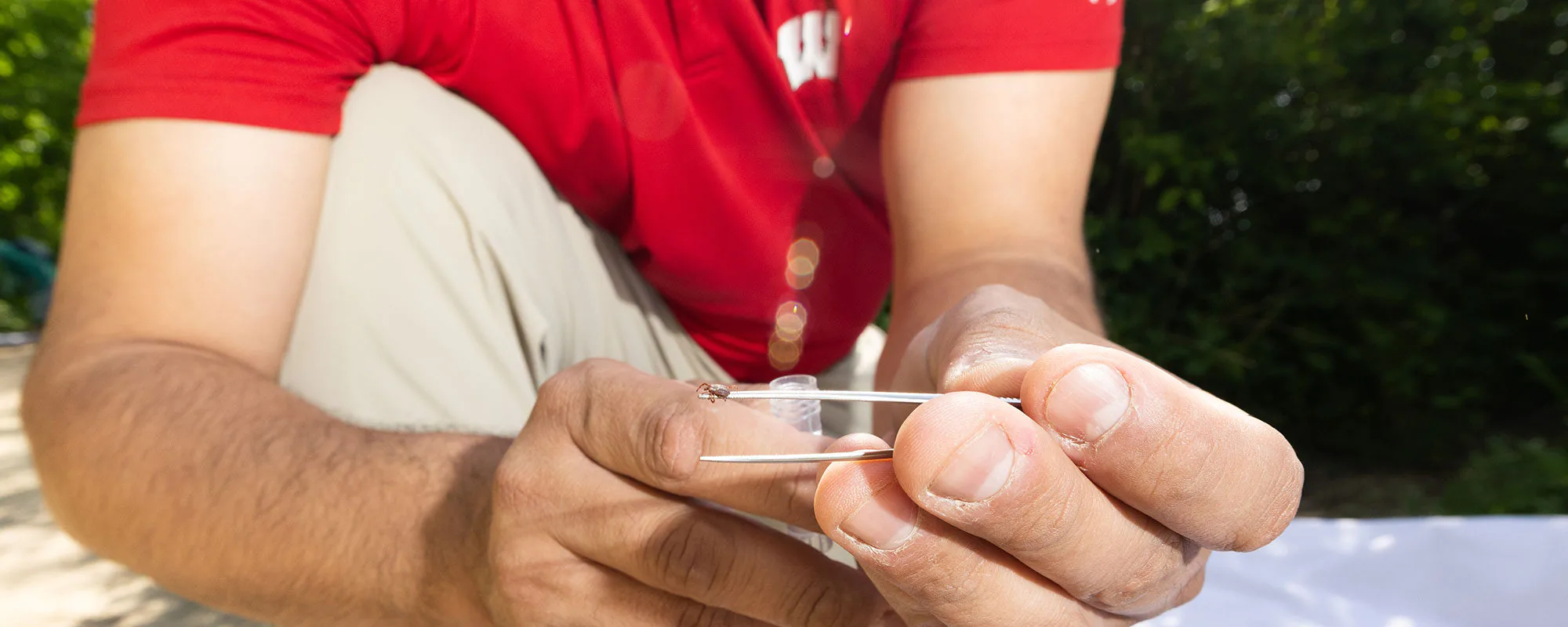
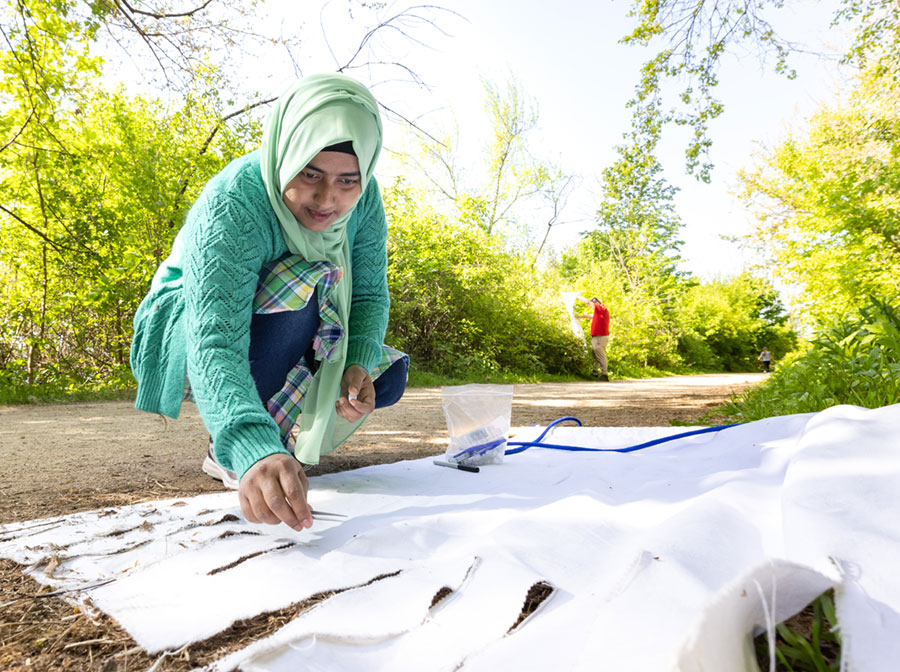
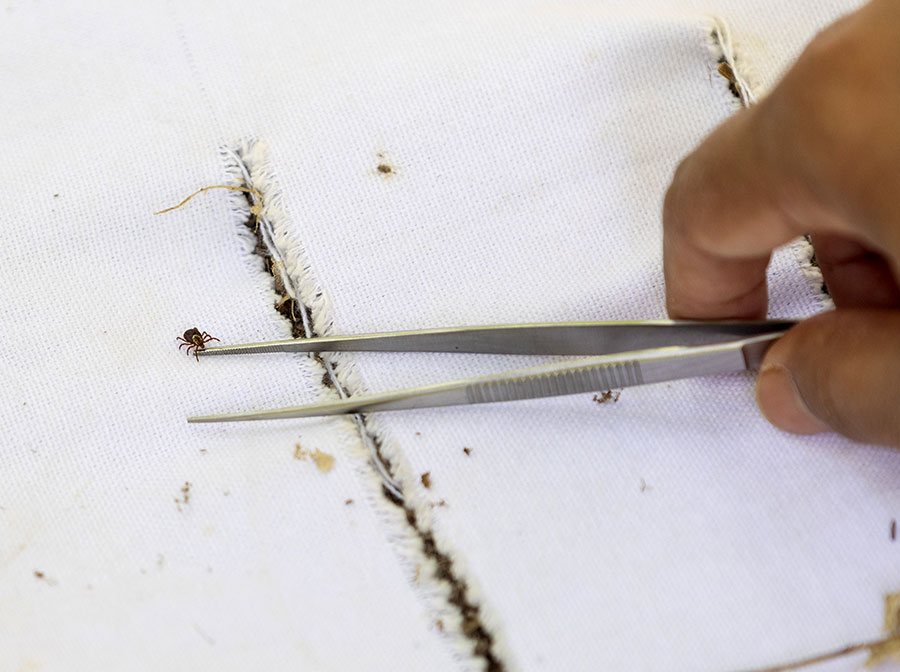
On a recent Friday morning at Picnic Point, a wooded path on campus, Uelmen and graduate students Sazeda Akter and Amanda Roling unfurled a 4’x4’ square of white denim, fringed with flaps. They dragged it over a 10-meter expanse of brush and grass, then stopped to check for ticks, looking closely because the tiny arthropods can be confused with seeds and even specks of dirt.
The work is central to a research project that Uelmen, an assistant professor of population health sciences and a disease ecologist within the University of Wisconsin School of Medicine and Public Health, is leading with funding from a New Investigator Grant from the Wisconsin Partnership Program. The goal is to improve how Wisconsin predicts, prevents and responds to tick-borne diseases.
Working with Akter and Roling in locations throughout Wisconsin this spring, summer and fall, Uelmen will collect as many tick species as possible to understand more about the risks to humans who share the ticks’ territory. He’ll integrate his field discoveries with climate and environmental data, drone imagery and community-submitted tick samples to develop advanced models showing when and where tick risks are highest in the state.
“As a disease ecologist, I study ‘zoonosis,’ which is when pathogens from animals are transmitted to humans,” said Uelmen, who earned a PhD in epidemiology at the University of Illinois. “Through ecological forecasting — which uses a variety of data to create reliable models of prediction, similar to weather forecasting — we can provide people with valuable information and knowledge that can help them stay safe.”
Using tweezers to drop collected ticks into vials filled with an ethanol solution, team members note tick quantity, species, life stage, date and location. They also plan to set out tick traps containing dry ice, which emits carbon dioxide, a cue used by many host-seeking ticks.
“Over the last few field outings, we have collected over two hundred ticks,” Uelmen said. “It’s early in the season to be finding so many at all life stages — larvae, nymphs and adults. The deer tick, also known as the blacklegged tick, nymphal stage is important for human disease risk, because nymphs are very small and easy to miss, and may already be infected after feeding.”
Tick ecology is complex and there are large gaps in knowledge. Uelmen’s team will share data with the Midwest Center of Excellence for Vector-Borne Diseases, located in Madison, and the Wisconsin Department of Health Services, as well as with the Marshfield Clinic Research Institute, in Marshfield, Wisconsin. An important project outcome will be a dashboard that clearly tracks short-term changes in tick populations and tick-borne diseases across the state. Users will be able to zoom in on a 5×5 kilometer grid anywhere in Wisconsin and determine their current or future risk, as well as view historic trends.
Among Midwestern states, Wisconsin is a geographic center for tick-borne diseases, including Lyme disease, anaplasmosis, babesiosis and ehrlichiosis (one strain of ehrlichiosis is even named for Eau Claire, Wisconsin, where it was first documented: Ehrlichia muris eauclairensis). Dr. Lindsay Voss, an internal medicine physician at UW Health and an associate professor in the Department of Medicine, said physicians are seeing more cases of tick-borne diseases than they did a decade ago, and the season starts earlier.
“Ten years ago, we would see tick bites starting in May or June,” Voss said. “Now, we’re seeing them as early as March.”
Not all species of ticks carry disease, but of the species that do, infection rates are increasing. More than half of the adult ticks sent in through the Marshfield Research Institute’s Tick Inventory via Citizen Science (TICS) project tested positive for the bacteria that causes Lyme disease, transmitted by Ixodes scapularis, or deer tick.
Health professionals are also monitoring Powassan virus — rare but dangerous, transmitted by the deer tick and found in Wisconsin — and alpha-gal syndrome, a red meat allergy triggered by bites from the range-expanding Amblyomma americanum, or lone star tick, among others.
As part of a weekly educational seminar series for faculty in the Department of Medicine, Voss discussed a recent case of alpha-gal that took months to diagnose. Her colleagues were shocked to learn that the lone star tick was in Wisconsin.
“My takeaway is that we need to have the lone star tick and alpha-gal syndrome, which is tricky to diagnose, on our radar now,” she said.
Voss said she would welcome a detailed Wisconsin dashboard like the one Uelmen is developing.
“Knowing what new tick species are emerging in our geographical area would be extremely helpful.”
While native ticks such as the deer tick and Dermacentor variabilis, or dog tick, have always been present in the state, their numbers are increasing and their ranges are shifting, likely due to climate change and human-driven alterations to their hosts’ habitats.
Uelmen characterized Dane County as a frontier, sandwiched between southern ticks (such as the lone star tick) migrating north and northern ticks (such as the native deer tick) migrating south.
“It’s all changing quickly,” Uelmen said. “The lone star tick historically ranged from the Southeast up to New Jersey, as well as the Gulf Coast and Texas. In the last dozen years, it has established across the Northeast and Midwest, including central and northern Illinois. While there is no evidence that the lone star tick is established in Wisconsin, we need to stay vigilant. Where are these invasive tick species going next? At what rates? These are some questions we want to answer through our project.”
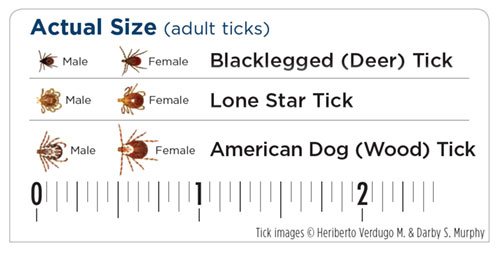
A tick identification card is part of the TICS citizen science kits created by Marshfield Clinic Research Institute.
Uelmen’s team plans to distribute tick collection kits from the Marshfield TICS project, a successful citizen science effort. The kits, which will be available soon at the UW Arboretum Visitor’s Center, allow hikers to send ticks they find to the Marshfield Research Institute for analysis, adding to the data bank.
“Citizen scientists can provide researchers with an enormous amount of information,” said Uelmen. “In the process, people become more educated, which is good for public health.”
“For so many tribal nations, the land is vital to who they are,” he said. “Potentially they are some of the most exposed populations when it comes to tick-borne diseases.”
The research team will share surveys with tribal communities and hold workshops where UW scientists and tribal members exchange knowledge about tick ecology, tick dispersal and tick-borne diseases.
Ultimately, the project aims to give Wisconsin residents clearer, more timely information about the risks in their area. Uelmen hopes people educate themselves, rather than panic. Voss takes a similar approach with patients.
“We want you to be outside — it’s good for you!” she said. “But be aware that ticks are everywhere and check yourself carefully after each outing.”
Photos by Media Solutions
This project is funded by a New Investigator grant from the Wisconsin Partnership Program, a grantmaking program within the University of Wisconsin School of Medicine and Public Health committed to improving health for all through investments in community partnerships, education and research initiatives. New Investigator grants support early-career faculty in initiating new, innovative research and/or educational approaches that address health and health equity in Wisconsin and beyond.