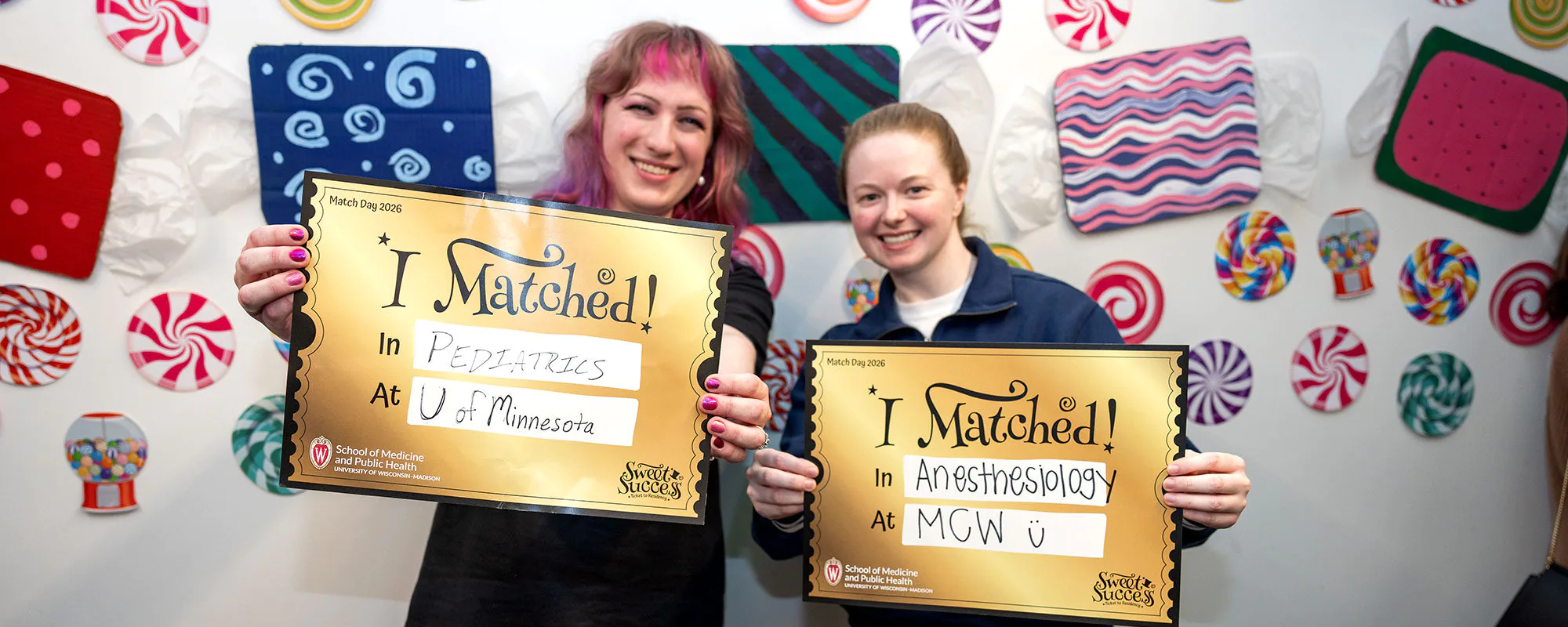
Cheered on by faculty members dressed as Oompa Loompas and pieces of candy, with the Archies’ “Sugar, Sugar” bopping from the speakers, fourth-year medical students filed onstage Friday at the University of Wisconsin School of Medicine and Public Health to announce where their residencies will take them next.
Assistant dean of students Dr. Sam Lubner and pediatrics associate professor Dr. Cathy Lee-Miller donned top hats and tails in the colors of sour grape and cherry to serve as Willy Wonka-style emcees. Lubner noted the similarities between Match Day and the classic children’s story “Charlie and the Chocolate Factory,” by Roald Dahl.
“It’s like opening a package that you worked really hard to earn,” he said. “It contains a magic ticket that will transport you to places you never thought you would go. What makes the story so compelling is that it comes with a dramatic change in the lives of our students.”
The UW students were part of a national Match Day ritual. At noon Eastern Daylight Time on the third Friday in March, medical students across the country learned where they had been placed for clinical residency training programs. At the UW School of Medicine and Public Health, Match Day is a celebration with friends and family, who cheered as the students opened their envelopes and shared their matches from the stage. Some of the biggest cheers were for those staying in Madison.
“I am so excited to be able to stay home; I hope to be able to practice medicine in Wisconsin for the rest of my life,” said Maddy Peterson, who matched in anesthesiology at UW Hospitals and Clinics. Peterson, who also has a nursing degree from UW and thus will be a “triple Badger,” will join classmates Gabriella Mullally and Jo Ellefson as anesthesiology residents at UW Hospitals and Clinics.
2026 Match Day at a glance
164 medical students matched to 24 specialties across the country.
99%
Matched
39%
Matched to family medicine, internal medicine or pediatrics residencies
28
States
Matches like these help address a critical issue facing health care in Wisconsin. According to the 2024 Healthcare Workforce Report from the Wisconsin Department of Health Services, Wisconsin will need an estimated 2,300 additional physicians by 2035. This could result in a shortfall of as many as 1000 doctors, with rural areas of the state bearing the brunt of the expected shortage of primary care physicians. Approximately one-third of the 2026 matching students will continue to call Wisconsin home in programs in Madison, Milwaukee, Waukesha and La Crosse.
Anesthesiology is among several specialties experiencing or projecting a physician shortage, with nationwide demand currently exceeding supply. Sixteen UW students matched into anesthesiology residencies.
Dean Nita Ahuja, MD, taking part in her first Match Day as leader of the school, offered advice from Willy Wonka: take care of yourself, don’t second-guess yourself, and dream big.
“Willy Wonka quoted a British poet [Arthur O’Shaughnessy] when he said, ‘We are the music-makers, and we are the dreamers of dreams’,” Ahuja said. “You had a dream when you started this journey and today, we start on the next stage. Incredible accomplishments have come out of this school and you will go on to make more accomplishments.”
Emcees Cathy Lee-Miller (left) and Sam Lubner welcomed students to Match Day wearing top hats and frock coats.
Dean Nita Ahuja (left) and Gwen McIntosh look on as students announce their residency matches.
Class presidents Jinan Sous, who matched in general surgery at the University of Colorado, and Elizabeth Fassbender, who matched in internal medicine at Emory University, were the lead planners for the day’s events.
From a list of choices, students voted for the theme of “Sweet Success: A ticket to residency.” The theme carried through the day, with a golden selfie background for photos and chocolate bars provided by the Wisconsin Medical Alumni Association. Just as in the story, one candy bar contained a golden ticket that won the student a basket of Wisconsin swag. The winner, Brittany Rodriguez, also snagged a golden ticket to a residency in neurology at her first-choice school, the University of Washington.
Nearly 40 percent of the class of 2026 will enter residencies in family medicine, internal medicine, or pediatrics. Of those three, pediatrics has trended upward in recent years, from 5.3 percent of the school’s class in 2022 to 10.4 percent this year. Many trainees in internal medicine and pediatrics will continue in primary care. Others will pursue fellowships or other forms of subspecialization in areas such as cardiovascular medicine, infectious disease, or nephrology.
Nationwide, Match Day broke records for residency position offers. Among 48,050 active applicants nationwide, the Match filled more than 93 percent of positions. Nationwide trends included strong participation in primary care specialties, as well as an increase in psychiatry positions (with a fill rate of 97.4). Though family medicine positions increased nationally this year, the fill rate declined from 85 percent to 83.6 percent (though the total number of applicants matching into the specialty increased this year). The National Resident Matching Program stated its intention to convene a panel to examine issues affecting family medicine’s growth and sustainability, as the specialty offers a critical pathway for patient access to care.
Top specialties
Top states
Helia Gagnon, family medicine
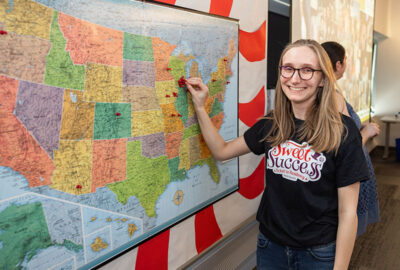
Helia Gagnon places a pin in the location of her residency.
When she arrived at the UW School of Medicine and Public Health, Helia Gagnon drew on some lessons remembered from her freshman year at Yale University, where she felt ill at ease until she met other first-generation, low-income (FGLI) students like herself and eventually became a mentor to them. Knowing how “imposter syndrome” can afflict these students, Gagnon helped found an FGLI organization within the UW School of Medicine and Public Health.
Gagnon, who grew up in Shawano County, also volunteered with the Voluntary Income Tax Assistance Program. Most Saturdays during tax season, she is at the Madison Central Library helping prepare tax returns for free for qualifying taxpayers.
“I found it really fulfilling to give back to other people who were low-income like me,” she said. “I wanted to continue that in my future by finding a career where I could serve people.”
Gagnon matched into family medicine in the UW School of Medicine and Public Health.
Hunter Bay and Tricia Siy, internal medicine
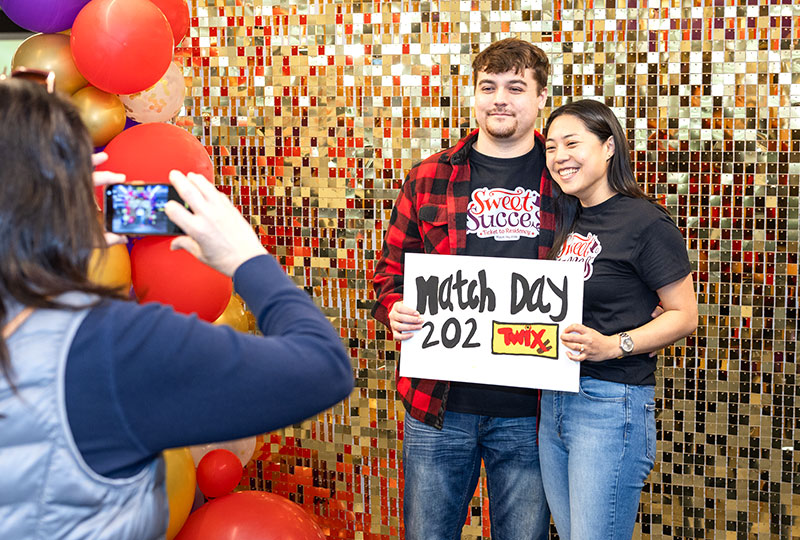
Hunter Bay and Tricia Siy come from very different backgrounds. Bay, the first in his family to graduate from college, grew up near the Chequamegon National Forest in far northern Wisconsin, where his father is a logger. He served in the Wisconsin National Guard, taught high school biology, and worked as an emergency medical technician before entering medical school. Siy, who grew up in the Milwaukee suburb of Brookfield, comes from a family of physicians. Her grandparents emigrated from the Philippines for medical training at several Midwestern medical schools.
They met during the first weeks of medical school. On her walk to school, Siy was saddened to see a gardener ripping out geraniums that were still blooming and asked if she could have them. But that left her holding an armful of muddy plants with class starting soon. Along came Bay, who gallantly produced a plastic bag from his backpack and helped her tote the plants up the street.
The two started dating, attended lectures together, and married over Thanksgiving weekend this past year, with a larger ceremony planned for later. Both found their calling in internal medicine.
“They tell you to ‘find your people,’ and the internal medicine folks were definitely my people,” Siy said.
During medical school, Siy volunteered with Madison Street Medicine, a local nonprofit that develops programming and services to fill gaps in access to health care and housing in the Madison area. She learned a lot about “meeting people where they are.”
Hunter Bay and Tricia Siy
Bay, a graduate of the Wisconsin Academy of Rural Medicine (WARM), a program focused on training doctors to practice in rural settings, is drawn to cardiology and rural medicine.
Both matched into internal medicine at UW Hospitals and Clinics. Where the couple lands after residency will be a matter of compromise.
“I’m trying to get her to go as far north as possible,” Bay joked.
Megan Baughman, orthopedic surgery
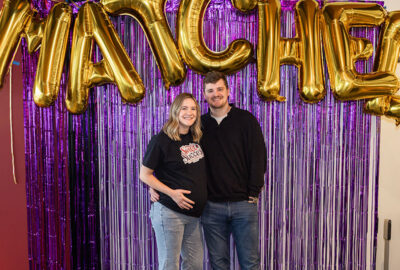
Megan Baughman and her husband, Hayden
While Match Day is a big event for all medical students, Megan Baughman has another important date circled on her calendar: March 29. That’s the due date for her first baby, a son she will welcome to the world with husband Hayden Baughman. The last day of her final orthopedics rotation is March 27.
“We are cutting it very close,” she said. “It’s been a whirlwind.”
Baughman’s final year of medical school coincided with pregnancy milestones. She found out she was pregnant while rotating at Mayo Clinic, and subsequent rotations took her to Iowa and Minnesota before she could return home. She said that having a child on the way shaped the way she evaluated future residency programs. Baughman matched into orthopedic surgery at UW Hospitals and Clinics.
Baughman, who has an undergraduate degree in biomedical engineering, had planned to be an engineer, but found herself more drawn to patients than devices. UW–Madison was her first choice for residency and keeps her close to family: her sister is a nurse, and her brother-in-law is a resident in plastic surgery, both at UW Hospitals and Clinics.
“Orthopedic surgeons have an amazing impact on people’s lives,” she said. “That was the biggest factor for me in deciding on a specialty. To be able to put people back in motion, relieve their pain, and help them return to the activities that give their lives meaning is incredibly rewarding and something I can’t wait to be a part of.”