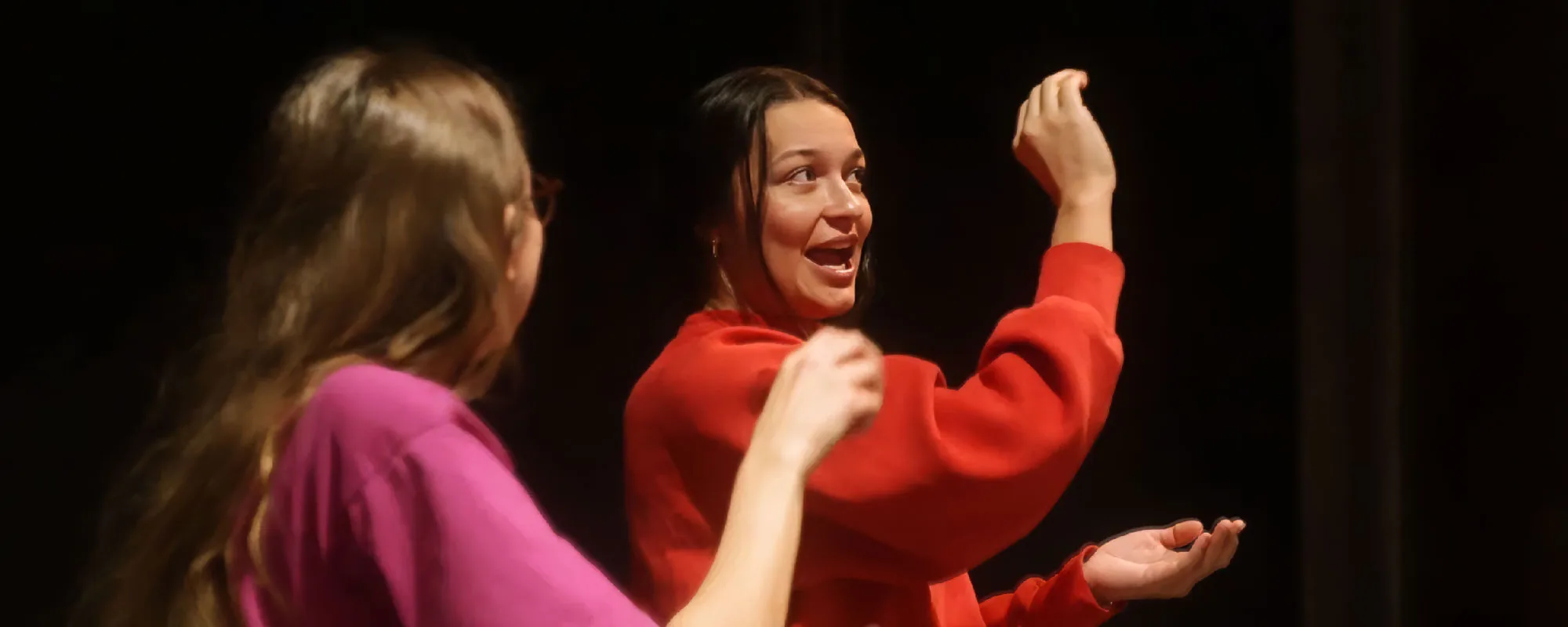
Gabriella Mullally, a fourth-year medical student at the UW School of Medicine and Public Health, learned of the class from a classmate who had already taken the elective. As Mullally prepared to graduate and move on to her residency training, the ability to communicate effectively in the professional world with colleagues and patients will be critical, she said.
“This class has already been going on for three weeks and I’ve already seen changes in the clinical setting,” Mullaly said. “When you are meeting a patient, you are meeting them for the first time on the spot, and I already feel much more comfortable.”
There is evidence to support the approach. In 2020 and 2025, Zelenski published papers detailing its success. The initial study, published in Academic Medicine showed that the students who participated in the class improved their ability to make others feel at ease, show care and compassion, communicate clearly, help others contribute, and create a consensus plan of action. The students also described improved interactions with patients and people outside of work.
The 2025 study, published in BMC Medical Education, showed similar results, but with the use of a virtual meeting platform to conduct the class, demonstrating that the benefits were not limited to in-person learning modality.
Anna Kreynin, another fourth-year medical student at the school, decided to take the course to challenge her own comfort level in the hope that it might improve her ability to manage stressful interactions with patients or colleagues.
Currently, much of Kreynin’s time is spent interviewing with residency programs around the country, and she has found that training offered through the improv course is also aiding her interview techniques.
“I’m in deep with interview season and I can definitely tell I feel a little bit less shy or not overthinking what I’m saying,” she said. “I can definitely see this being helpful when I go back to the clinical setting.”
As the students practice their newfound improv skills, spontaneity rules the moment and laughter often rings out. These moments of levity are welcome for students who have spent years studying and preparing for challenging, often serious clinical situations.
“There’s been a lot of laughter, and I’ve been really surprised how good some of my classmates are, not that we are in this to be professional improvisers,” Kreynin said.
An earlier version of this article incorrectly stated that the improv course is limited to medical students. The course is available to all health professions students.