

Stem cells’ light signatures improve understanding of aging in the brain

Midlife testing may help predict later cognitive impairment
When researchers test motor skills, hearing, vision and smell in people in their midlife, they are better able to identify those who may develop cognitive decline or impairment 10 years later, according to a new study by researchers at the University of Wisconsin School of Medicine and Public Health.

Gut inflammation linked to aging and Alzheimer’s disease
A new study by researchers at the University of Wisconsin School of Medicine and Public Health suggests a link between gut inflammation and changes in the brain and declines in memory, further supporting a connection between the gut and brain in Alzheimer’s disease.
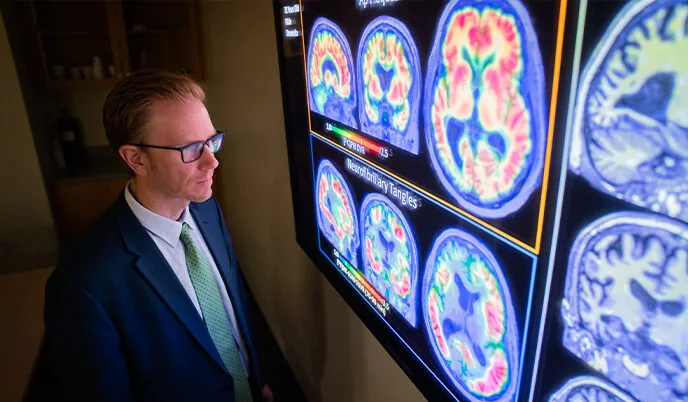
UW–Madison receives $150 million grant to lead nationwide Alzheimer’s disease study
The University of Wisconsin School of Medicine and Public Health has been awarded funding from the National Institutes of Health for a nationwide research initiative to investigate the neurobiology of Alzheimer’s disease and related dementias.

UW study examines potential treatment for Alzheimer’s disease
Researchers at the University of Wisconsin School of Medicine and Public Health are investigating whether the drug leuprolide, which is approved for prostate cancer in men, can be used to treat symptoms of Alzheimer’s disease in women.

Study explores midlife factors associated with blood biomarkers of neurodegeneration and Alzheimer’s disease
Lifestyle and chronic health conditions in middle age, along with a person’s education level, show associations with emerging blood markers of neurodegeneration and Alzheimer’s disease, according to a new study by researchers at the University of Wisconsin School of Medicine and Public Health.

Nursing home residents benefit from rapid flu testing
Rapid on-site testing of nursing home residents for influenza allowed earlier detection of outbreaks, faster treatment with antiviral medication and much lower hospitalization rates, according to a new study from researchers at the University of Wisconsin School of Medicine and Public Health.

Alzheimer’s, related dementias cause high economic burden among Indigenous populations
Indigenous people living in Wisconsin and throughout the nation experience significant health and financial burden from Alzheimer’s disease and related dementias, according to new research published by a University of Wisconsin–Madison team and collaborators.
Researchers identify ways to improve emergency care for people living with dementia
A new collection of research papers sets out priority areas to better provide emergency care for people living with dementia in the United States.

UW shows strong presence at Alzheimer’s Association International Conference
The world’s largest and most prestigious Alzheimer’s disease conference is underway this week, and UW Alzheimer’s disease researchers are attending in high numbers, leading several important discussions.
UW awarded research funding to identify ways to improve emergency department visits for people with dementia
The University of Wisconsin School of Medicine and Public Health is one of four sites awarded a total of $7.5 million from the National Institutes of Health (NIH) to conduct research that could lead to improved care in emergency departments for people with dementia.

Darcie Moore selected as 2020 Vallee Scholar in recognition of research
Darcie L. Moore, PhD, assistant professor of neuroscience, has been named by the Vallee Foundation as a 2020 Vallee Scholar. The award provides $300,000 in funding for basic biomedical research over four years.