

Study: Higher social media engagement with marijuana marketing linked to higher rates of use
One in three youth in states with legal recreational marijuana (cannabis) engage with marijuana brands on social media.

Jonathan Patz elected to National Academy of Medicine
Jonathan Patz, MD, MPH, professor and director of the Global Health Institute at the University of Wisconsin–Madison, has been elected a member of the National Academy of Medicine in recognition of his pioneering research showing the risk global climate change poses for human health.

Prevention Research Center to focus on mother-baby health
Wisconsin’s first Prevention Research Center is coming to UW–Madison thanks to a five-year, $3.7 million grant from the Centers for Disease Control and Prevention.
Carbone Cancer Center oncologist identifies unconscious gender bias
When speaking at the world’s largest international oncology conference, female speakers were addressed less often by their professional title compared to male speakers, and were more likely to be introduced by their first name only.
Study: Face-to-face communication key to job satisfaction in primary care clinics
Frequent face-to-face communication among all care team members in primary care clinics may boost overall job satisfaction for health care professionals, according to a recent study by the University of Wisconsin School of Medicine and Public Health.
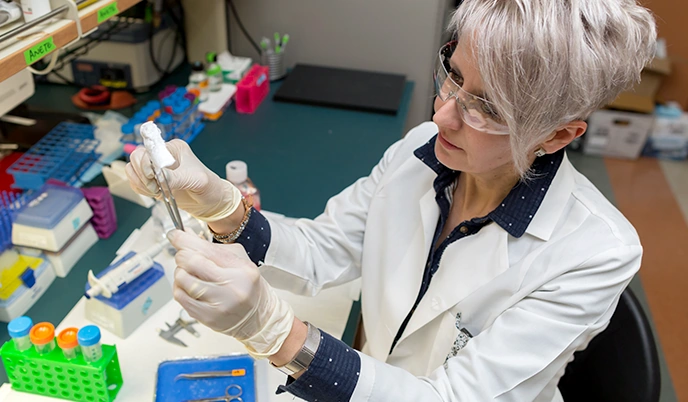
UW researchers use stem cells to develop vocal folds in a dish
Researchers at University of Wisconsin School of Medicine and Public Health have created an in vitro 3-D model of human vocal fold tissue (called mucosa) that could improve our understanding and treatment of disorders affecting the human voice.
Biostatistics and medical informatics tapped for $11.8 million national coordinating center
A University of Wisconsin-Madison professor and his team have been chosen to lead the nation’s coordinating center for the National Cancer Institute (NCI) Cancer Prevention Clinical Trials Network (CP-CTNet).

Michael Newton named chair of biostatistics and medical informatics
A leader in the use of statistical computing and inference in areas including genomics, molecular biology and cancer, Michael Newton, PhD, has been named chair of the Department of Biostatistics and Medical Informatics at the University of Wisconsin School of Medicine and Public Health.
Thomas ‘Rock’ Mackie receives gold medal from radiation oncology society
Cancer research conference focuses on targeted radionuclide therapy
University of Wisconsin-Madison is hosting a national conference on targeted radionuclide therapy (TRT), a promising new technology that combines cytotoxic radioisotopes with molecularly targeted agents to produce an anti-cancer therapy capable of treating local or systemic disease.

Michael Abernethy named to Federal Department of Transportation committee
‘Clamp’ regulates message transfer between mammal neurons
A fundamental question in nerve biology brings to mind a race car at the starting line: The engine is revving, but the brake is on. The system is ready to go, but under tight control.