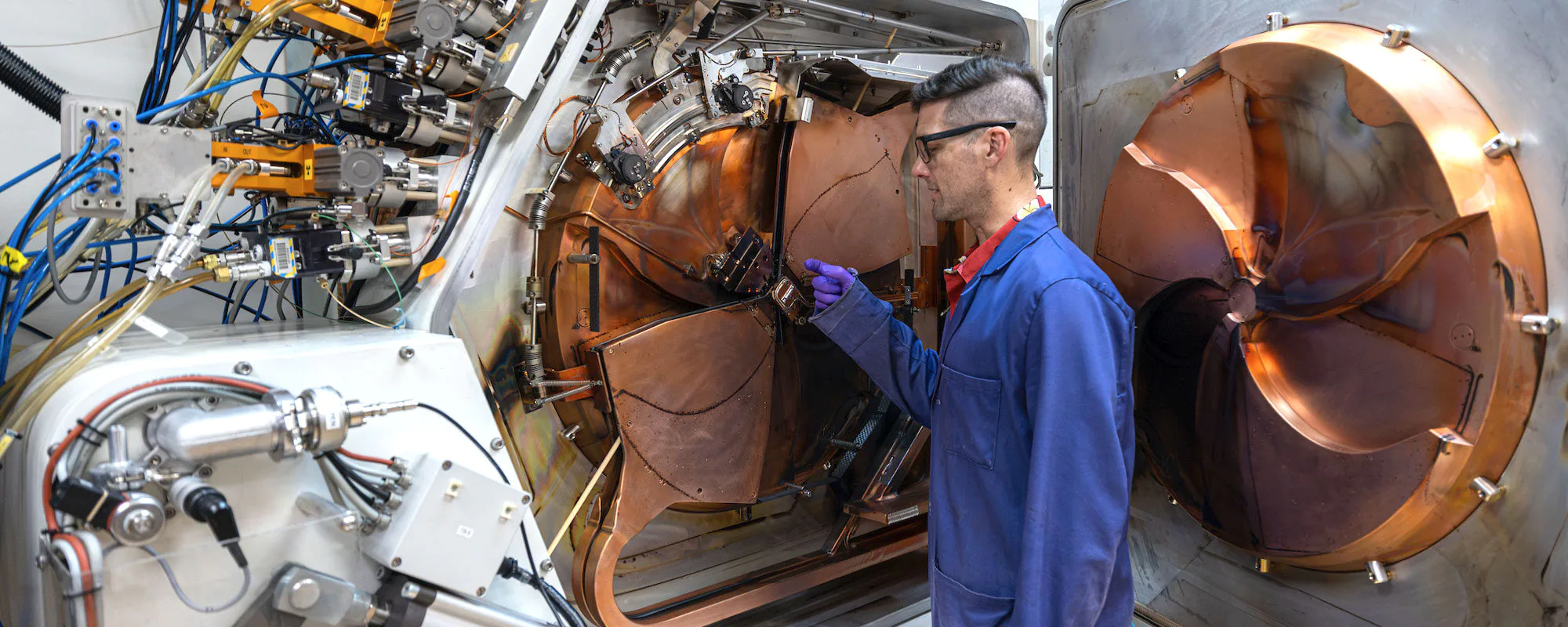
Jonathan Engle explains how one of the university’s existing cyclotrons produces radioisotopes that can be used in cancer treatment and advanced medical imaging.
Share
The University of Wisconsin School of Medicine and Public Health on Friday broke ground on a $62 million cyclotron expansion project to bolster access to cutting-edge medical imaging and targeted therapies for diseases like cancer and Alzheimer’s.
Funded partially through a grant from the National Institutes of Health as well as support from the Wisconsin Alumni Research Foundation and private donations, the 13,000-square-foot facility, located within the existing Wisconsin Institutes for Medical Research complex, will house the first modern alpha-particle cyclotron of its kind installed in the United States. The expansion will advance UW–Madison’s pioneering “theranostics” hub — an innovative medical approach that combines pinpoint diagnostic imaging with targeted radiation therapies to seek-and-destroy cancer cells without damaging healthy tissue.
Small particles, big possibilities
A cyclotron is a particle accelerator that uses magnets and electricity to speed up charged subatomic particles to create radioisotopes. Those radioisotopes release energy as they decay. Doctors can link radioisotopes to disease-specific molecules that allow them to track signals with medical imaging or target diseased cells, including cancer cells. Such radiopharmaceuticals are powerful tools used to deliver radiation to the body for diagnosis and treatment with pinpoint accuracy.
“This investment ushers in a new era in how we translate scientific discoveries directly into precision patient care,” says Nita Ahuja, dean of the UW School of Medicine and Public Health and UW–Madison vice chancellor for medical affairs. “By placing research, imaging, and clinical care under one roof, our scientists and doctors can work side-by-side to develop targeted therapies that attack disease while sparing healthy tissue. This isn’t just about advancing science — it’s about giving patients better treatments, more time with their families, and a future defined by hope, not fear.”
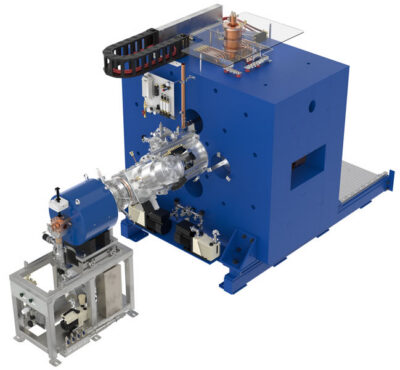
TR-ALPHA cyclotron (Photo courtesy of Advanced Cyclotron Systems, Inc.)
The project, which is expected to be completed by May 2028, will add two cyclotrons to the university’s already capable infrastructure, increasing current radioisotope production capacity two- to eight-fold, depending on the isotope. Shielded behind eight-foot-thick concrete walls, these machines will be capable of producing new types of medical radioisotopes, including the rare and short-lived Astatine-211, an alpha-emitting radioisotope with unique properties. These capabilities will give researchers and clinicians the opportunity to discover new treatments for diseases like cancer while also making advances in medical imaging.
“UW-Madison is one of the few places where expertise in medical physics, radiochemistry, engineering, pharmacy, imaging science, and clinical medicine comes together at scale,” says Anjon Audhya, vice dean for research at the UW School of Medicine and Public Health.
“With visionary support from WARF and major investments from our federal agencies, including the National Institutes of Health, this expansion positions Wisconsin as a national hub for theranostics innovation,” he adds. “It will accelerate the development of new diagnostics and targeted therapies while creating unprecedented opportunities for scientific discovery, clinical trials, and industry partnership.”
Expanding the reach of precision medicine
While cancer treatment is a significant focus of the new facility, the materials made by the new cyclotron will also support imaging for other health conditions. Radioisotopes power advanced medical scans called PET (positron emission tomography) and SPECT (single photon emission computed tomography), which help researchers and doctors detect, track, and treat Alzheimer’s disease, Parkinson’s, heart conditions, tissue injury, and chronic pain, among others.
The new cyclotron lab facility will be built between two research buildings on Highland Avenue (rendering courtesy of Potter Lawson). Left to right, Provost John Zumbrunnen, Regent Amy Bogost, Dean Nita Ahuja, Bucky Badger, Secretary Kathy Blumenfeld, and Vice Chancellor Dorota Grejner-Brzezinska attend the lab groundbreaking ceremony.
The expanded facility will also support a growing portfolio of theranostic clinical trials at UW Health, enabling patients to gain earlier access to promising new diagnostic and therapeutic approaches developed in Wisconsin and across the nation.
The new space will also serve as a training ground for the health care workforce that will lead the fields of molecular imaging, radiopharmaceutical science, and precision medicine, says UW–Madison Provost John Zumbrunnen.
“Scientists, clinicians, engineers, radiochemists, pharmacists and health professionals will learn here,” Zumbrunnen says. “They will get hands-on experience across the entire continuum, from isotope production and radiochemistry to molecular imaging and theranostics. Very few institutions can offer training that spans both the foundational science a cyclotron enables and its clinical translation into precision diagnostics and targeted treatments. UW–Madison will be one of them.”
The facility, which has shipped radioisotopes nationally for the past decade as a member of the U.S. Department of Energy University Isotope Network, will expand its supply of essential radioisotopes to clinical trials and research centers across the country. In this way, UW–Madison will help enable the discovery of leading-edge treatments for some of the world’s most challenging diseases.
“Doctors and scientists across the nation are eager to design more effective treatments and improve diagnostic scans, but they’re being held back by a national shortage of medical isotopes,” says Jonathan Engle, director of the UW–Madison Cyclotron Research Group and an associate professor of medical physics and radiology. “By building this national resource in Madison, we’re supplying the essential raw materials needed to accelerate cancer and Alzheimer’s research while ensuring patients get faster access to pinpoint treatments.”
That innovation and knowledge sharing is the Wisconsin Idea in practice, says UW–Madison Vice Chancellor for Research Dorota Grejner-Brzezinska.
“This research investment will unlock more pathways for translational research, where discoveries in the lab can become innovative treatments for our patients — turning federal research dollars into medical solutions that directly benefit the people of Wisconsin and beyond,” she adds.
A catalyst for growth and discovery
Beyond advancing research and patient care, the project will strengthen Wisconsin’s growing radiopharmaceutical sector by training the next generation of radiochemists, medical physicists, engineers, and physician-scientists. The facility is expected to support biotech startup formation, attract industry partnerships, and expand regional manufacturing capabilities.
When completed, the facility will further establish UW-Madison as a leading destination for theranostics research, radiopharmaceutical development, and precision medicine, helping bring next-generation diagnostics and targeted treatments to patients in Wisconsin and around the world.
Banner and groundbreaking photos by by Sirtaj Grewal/Media Solutions
This research was supported by National Institutes of Health Grants 1C06OD036005-01 and 1S10OD038200-01.