No cure exists — yet — for Alzheimer’s disease, the brain disorder that slowly destroys memory and thinking skills, along with the ability to complete daily tasks. But dozens of researchers at the University of Wisconsin–Madison, many of them within the UW School of Medicine and Public Health, are working on ways to prevent, slow and cure the disease.
They are also helping people affected by Alzheimer’s disease and related dementias, including family members and caregivers, live healthier, happier lives.
UW is a national leader in this realm. The Alzheimer’s Disease Research Center (ADRC) within the UW School of Medicine and Public Health, led by Dr. Sanjay Asthana, professor of medicine, is one of 36 designated ADRCs in the country. Through funding from the National Institutes of Health and the National Institute on Aging, the center supports researchers pursuing ways to prevent and treat Alzheimer’s disease. UW is also home to the Wisconsin Alzheimer’s Institute (WAI) and its Wisconsin Registry for Alzheimer’s Prevention (WRAP), one of the world’s largest and longest-running studies of individuals at risk for Alzheimer’s disease. Researchers rely on WRAP data to learn more about biological, health and lifestyle factors linked to the disease.
With more than 7.2 million Americans aged 62 and older living with Alzheimer’s — including more than 120,000 in Wisconsin — the research, education, clinical care and community engagement led by researchers at UW–Madison has an outsized impact in Wisconsin and around the country.
Sterling Johnson
Sterling Johnson, PhD, a professor in the Department of Medicine, is leading a national research initiative to detect and stage a person-level mixture of neurodegenerative disease, which involves identifying the presence of multiple, overlapping brain diseases in a single individual, measuring how much of each is present, and determining the severity, or stage, of the condition. The study, called The ADRC Consortium for Clarity in ADRD Through Imaging (CLARiTI), includes 2,000 participants from all 36 ADRCs in the United States. Participants span the etiologic spectrum, which means they represent the full range of different causes of a specific neurodegenerative disease, symptom or condition. Johnson’s team will establish standardized brain imaging and blood plasma test protocols to analyze levels and types of two proteins, amyloid and tau, which are hallmark biomarkers of Alzheimer’s disease. By developing systematized imaging of amyloid, tau and other neurodegeneration biomarkers, CLARiTI researchers aim to identify all intersecting causes of cognitive impairment, not just Alzheimer’s disease. The CLARiTI study supports the centers’ work under an FDA-grade compliance framework.
Nathaniel Chin
For Dr. Nathaniel Chin, an associate professor in the Department of Medicine, addressing dementia is a personal mission. His father succumbed to the effects of Alzheimer’s disease, and Chin honors his memory by exploring the ways people can prevent, slow and live well with the disease. A key focus for Chin is providing practical advice to the public and sharing the latest news on research and care. He recently published When Memory Fades, a practical guide for individuals and families navigating cognitive change before, during and after a diagnosis. He hosts the podcast Dementia Matters, which brings listeners helpful, timely information on Alzheimer’s disease and related dementias, including the latest research on diagnostics, treatments, lifestyle interventions and caregiver resources. The show is listed as a top caregiving and research resource by the National Institute on Aging. Chin also co-hosts the online series Healthy Living with Mild Cognitive Impairment (MCI), connecting people across Wisconsin and beyond with science-backed education on brain health and practical tools to support living well with MCI. Chin serves as medical director for both ADRC and WRAP, overseeing research that advances earlier detection of Alzheimer’s disease through blood-based biomarkers that may be present years before symptoms appear.
Barbara Bendlin
Recent studies led by Dr. Barbara Bendlin, professor of medicine, suggest a link between the gut microbiome and neurodegenerative diseases. After her discovery that Alzheimer’s disease patients have reduced diversity of microbes in the gut, Bendlin set out to find out why, and whether gut bacterial communities could be a target for therapeutic intervention. Less microbial diversity can lead to microbiome imbalance and inflammation. In a later study, Bendlin’s team found that when levels of calprotectin, an inflammatory marker, increased in the gut of those with Alzheimer’s disease, so did the amount of amyloid plaque accumulating in their brains. Levels of biomarkers for the disease also rose in cerebrospinal fluid, and test scores of the volunteers’ verbal memory function dropped. Gut inflammation rises with older age, and Bendlin theorizes that this age-related inflammation could be linked to increased risk for neurodegenerative diseases. In 2025, Bendlin led a study that found that gut microbiome composition and function differed between individuals with Alzheimer’s disease and those without, showing that gut microbes and their pathways may play a role in Alzheimer’s disease and related dementias.
Henrik Zetterberg
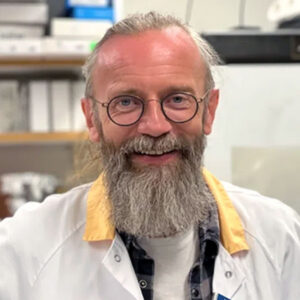
Dr. Henrik Zetterberg searches for biomarkers in blood and spinal fluid that identify two proteins, TDP-43 and alpha-synuclein, both of which appear to play a role in the development of neurodegenerative dementia. Understanding biomarkers is critically important, as they can indicate disease before symptoms appear. Zetterberg, a professor of pathology and laboratory medicine, co-leads ADRC’s Biomarker Lab, a facility where researchers examine biofluids for clues related to brain health or brain function. The team’s insights could lead to improving the molecular diagnostics of brain diseases like Alzheimer’s that rarely have a single cause. Earlier diagnosis could lead to treatments that help patients live longer, symptom-free lives. Zetterberg, one of the world’s leading dementia researchers who joined the School of Medicine and Public Health faculty in 2025, intends to develop methods that can detect neurodegenerative brain changes, including those of Alzheimer’s, in the early, symptom-free stage of the disease. Cutting-edge technologies, including mass spectrometry, an analytical technique that measures the ratio of mass to electric charge in molecules, and ultrasensitive, multiplexed immunoassays, which allow Zetterberg and his colleagues to measure many more proteins in small volumes, are making it possible to build a biobank with a broader panel of protein biomarkers that can be tested in new ways.
Art Walaszek
For Dr. Art Walaszek, taking a public health approach to Alzheimer’s disease is critical to addressing the everyday difficulties of people living with behavioral and psychological symptoms of the disease, as well as their family members and caregivers. Walaszek, a professor in the Departments of Psychiatry and Medicine and associate dean for faculty affairs and development, directs the public health pillar of WAI and co-leads ADRC’s outreach, recruitment and engagement core. Walaszek’s WAI team conducts public health research to improve dementia care through teaching health care professionals and dementia care specialists across the state how to better assess and manage patients’ dementia symptoms. The team also developed a curriculum for the school’s medical students on caring for people with dementia. Walaszek believes that improving understanding of Alzheimer’s requires reaching out to people in many different ways. He directs the ADRC’s annual Fall Community Conversation, speaks frequently at public events, has written a book on the symptoms of dementia, serves as a guest on radio shows and podcasts, is active on social media and moderates discussions in communities around Wisconsin. His goal is to help people stay connected, improve their brain health, support memory and live healthier, happier lives.